

What can you build in the Netherlands without a permit? We explain it to you.
This is regulated in in the ‘Environmental Law Decree’, in short, the ‘BOR’ (Besluit Omgevingsrecht).
You need to know this in advance
Building without permits only applies to houses that are NOT a monument, NOT a protected cityscape or village view or that are not subject to any other public law restriction. How do you find out if this applies to your house? You can find this at the Land Registry.
Furthermore, you should always build according to the requirements of the latest building decree and you have to take neighborly law into account.
Ordinary maintenance
In principle, you do not need a permit for regular maintenance on your home. However, the rule is that the detailing, profiling and design of your home may not change as a result of maintenance. In principle, the same applies to monuments as above, but there is an extra important rule that the material types and color may not change. If you want to change things on the inside of the monument during maintenance, this is only allowed if the relevant parts have no value from the point of view of monument conservation. Simply explained: you live in a monument that already has been completely modernized on the inside and where nothing is left in its original state. In that case, it doesn’t matter if you change things inside.
If the municipality obliges you
The municipality may oblige you as a property owner to do something about your house. For example, if your windows are about to fall out of the walls, your roof is about to collapse or the walls are about to collapse. But it is also possible that the appearance of your home conflicts with the reasonable requirements of prosperity. In that case, the municipality (or another competent authority) can oblige you to make changes to your house within a certain period. According to the BOR, Annex II, Article 2, paragraph 2, these are not subject to a permit.
An extension or outbuilding in the garden (separate blog)
This is perhaps the most interesting license-free issue. This can be anything. A storage room, a garden house, an office, a sauna, extension, etc. But this must exactly meet a list of requirements. Because this is a fairly extensive topic, we have written down the explanation for this topic in this separate blog.
A dormer window
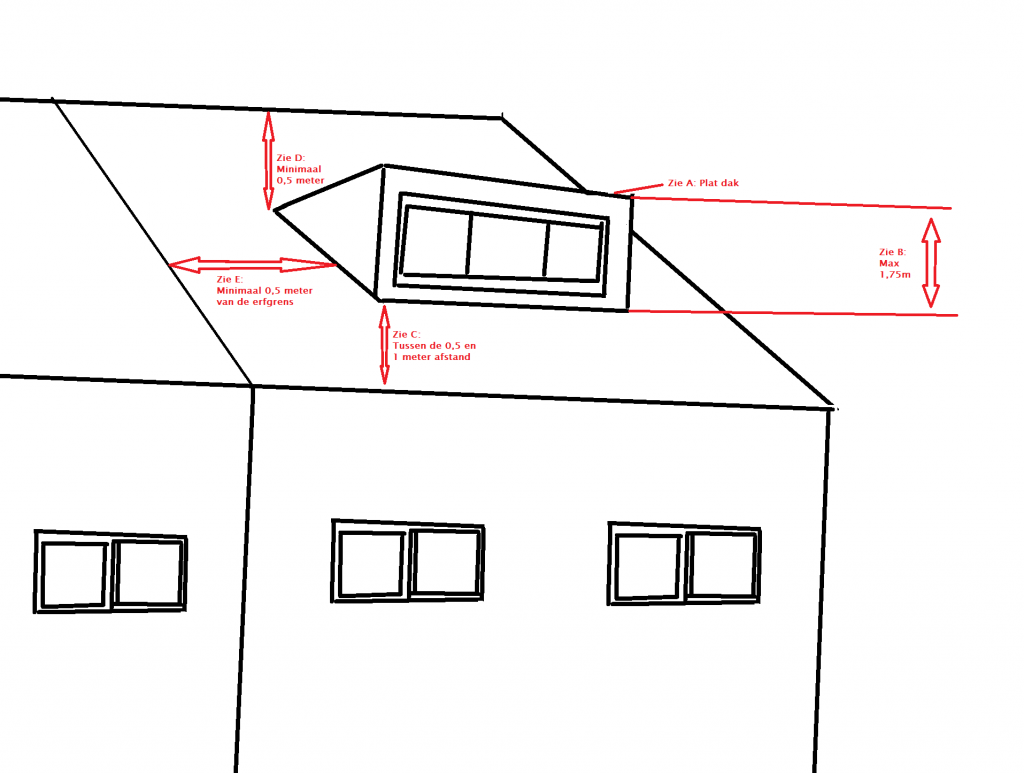
You can place a dormer window on your house without a permit if it is located at the rear of your house. You can also place a dormer window on the side of your house without a permit if it does not overlook ‘publicly accessible area’. So, for example, if you want to place a dormer window on the side of your house and there is no road, park, waterway or, for example, a park alongside your house, you can install that dormer window without a permit. You can do this, if you keep the following rules in mind:
A. The dormer window must have a flat roof
B. The height of the dormer window, measured from the foot of the dormer, may not exceed 1.75 m
C. The underside of the dormer window should be between 0.5 and 1 meter from the roof base
D. The top of the dormer window must be at least 0.5 meters below the roof ridge
E. The sides of the dormer window must be at least 0.5 meters from the sides of the roof surface or the yard boundary
F. Furthermore, a dormer window may not be placed on a caravan, a holiday home or a temporary home without a permit
It visually looks like this:
A skylight or similar daylight facility
If you want to place this at the back or on the side of your house, then only the following rules apply:
If you want to place a daylight facility at the front of your house, the following rules apply:
A. It is only allowed without a permit on the side of your house if the side where you place the dormer window is not adjacent to a publicly accessible area.
B. The daylight facility should not protrude more than 0.6 meters beyond the roof surface.
C. If you want to place a daylight facility at the front of your house, the following rules apply:
D. If reasonable welfare requirements DO apply in your street, then you may not protrude the daylight supply above the roof surface.
E. If NO reasonable standards apply, daylight facility may protrude a maximum of 0.6 meters above the roof surface.
F. Also, the sides of the daylight facility/barrel vault must be at least 0.5 meters away from the sides + top + bottom of the edges of the roof surface.
Solar panels / solar collectors
Especially nowadays this is important to know. You may place solar panels and solar collectors on your roof(s) without a permit under the following rules:
Rules for panels/collectors on a SLOPED roof:
A. All panels/collectors must fit within the roof plane. So, for example, do not protrude from the bottom, top or side.
B. The panels/collectors must be placed in or directly on the roof surface. So not on another separate construction.
C. The angle of inclination of the panels/collectors must be equal to the angle of inclination of the roof surface.
D. The installation itself (in the case of a solar water heater, think of the boiler tank itself) must be installed indoors. Quite logical, because of course you don’t want all houses in the street where, apart from the panels/collectors, there are also all installations on the roof(s).
Rules for panels on a FLAT roof:
A. The panels/collectors should not extend all the way to the side of the roof. The height of the solar panel is also the minimum distance you keep from the roof boundary of the flat roof.
B. Here too, the installation itself (in the case of a solar boiler, consider the boiler itself) must be placed indoors.
Windows, facade panels and accessories
This is about window frames and window frame infill. When filling in the window frame, think, for example, of the structure of the window frame (8 small windows instead of 1 large window).
- The basic rule is very simple: if it is at the rear of your home, then it is no problem.
- On the side of your house is also no problem, as long as the side of your house is not directly adjacent to a publicly accessible area. If the side of your house borders directly on the street, you need a permit.
- In principle, it is also allowed in an outbuilding in the backyard, provided it is at least 1 meter away from publicly accessible area and no reasonable welfare requirements apply.
Awnings, roller grilles, blinds and shutters
Awnings, roller grilles, blinds and shutters are permit-free on each side of your house (the main building).
In an outbuilding, sun blinds, roller grilles, blinds and shutters are only subject to a permit if this is at the rear of the house and/or if it does not directly overlook an area accessible to the public. So, for example, if you want to place a roller shutter in an outbuilding (garage) on the street side of your house, you must meet 2 additional requirements, which are the following:
- The sunblinds, roller grilles, blinds and/or roller shutters must be on the inside of the external partition construction (read: wall).
- At least 75% provided with crystal clear see-through openings. This latter concept is so vague (also for us), that it is strongly recommended to first do a permit check with the municipality.
Separation at balconies and roof terraces
A balcony, roof terrace or a fence (fall protection) is always subject to a permit. However, making a partition to the neighbors is always without a permit.
Garden furniture
Garden furniture that you want to make or place is always permit free, as long as it is not higher than 2.5 meters. Street furniture (think of a bench along your driveway) is always without a permit.
Playground equipment or sports equipment
Think of a climbing frame, swing or outdoor fitness. This is permit free if the following rules are met:
- It should not be higher than 2.5 meters
- It may only be driven by gravity (think of a slide) or the physical strength of a human (so no automatic merry-go-round or automatic seesaw)
A fence (yard or plot separation)
The basic rule is very simple: you can always place a fence or other plot separation without a permit if it is a maximum of 1 meter high.
You may also install a fence/plot fence of a maximum height of 2 meters without a permit, but then the following conditions must be met:
- It may only be installed at least 1 meter behind the front of your house. So you can’t just put a fence of 2 meters high in your front yard.
- If reasonable welfare requirements apply in your area, then the fence/yard separation of 2 meters high must be at least 1 meter away from publicly accessible area.
- There must already be a house or other structure with which the fence or boundary is ‘in functional relationship’. If there is already a house, this is almost always the case.
A construction to bridge terrain height difference
It must be no more than 1 meter and not higher than the adjacent finished site.
flagpole
You may place 1 flagpole per yard without a permit. The maximum height of the flagpole may be 6 meters.
Waste container(s)
You may place or make these as long as they are not higher than 2 meters and if they are placed above ground, the surface may not be more than 4 m2. It also only concerns containers for household waste, so not for commercial waste, for example.
Another building
You may also place a ‘construction’ over your entire plot without a permit, as long as it is no higher than 1 meter and no larger than 2 m2.
These are the most important permit-free things that you can build. There are other permit-free things that you can build, but we have omitted them here because they occur less often. Consider, for example, antenna installations. If you want to see a complete overview, just google ‘Decision Environmental Law – appendix 2’. Goodluck!